History · Preparing the way

Three centuries of the Bible in Welsh

Before the missionaries of 1840 ever reached Flintshire, Wales had been prepared by generations of scripture, schooling and revival in its own language. This is the ground the pioneers grew from.

c.1545–1604

William Morgan and the Bible in Welsh

William Morgan was born about 1545 at Tŷ Mawr Wybrnant, in the parish of Penmachno near Betws-y-Coed — the son of John ap Morgan ap Llywelyn, a copyholder on the Gwydir estate, and Lowri. He entered St John’s College, Cambridge, in 1565, graduating BA in 1568, MA in 1571, BD in 1578 and DD in 1583, and was ordained deacon and priest in 1568.

William Salesbury had published his Welsh New Testament in 1567. Morgan believed just as firmly in a Welsh Old Testament, and while rector of Llanrhaeadr-ym-Mochnant he completed his own translation, published in London in 1588 as the complete Welsh Bible — his Old Testament with a revision of Salesbury’s New Testament. The poet Edmwnd Prys, born only twelve miles from Morgan’s birthplace and his contemporary at Cambridge, assisted with the translation. Morgan was consecrated Bishop of Llandaff in 1595, became Bishop of St Asaph in 1601 and died on 10 September 1604.Records differ on his birth year: the Dictionary of Welsh Biography gives about 1545, from evidence in his 1568 ordination application; his Cambridge memorial gives 1541.

His father was a tenant of the Gwydir estate, and William was probably educated at Gwydir Castle near Llanrwst. He then attended St John’s College, Cambridge, where among other subjects he studied philosophy, mathematics and Greek, taking his Bachelor of Arts in 1568 and his Master’s in 1571. Seven years of Biblical study followed, including the Bible in Greek, Hebrew and Aramaic; he graduated Bachelor of Divinity in 1578 and Doctor of Divinity in 1583. His memorial at Cambridge gives his birth year as 1541 rather than about 1545.

At Cambridge he was a contemporary of the Welsh clergyman and poet Edmwnd Prys, born only twelve miles from Morgan’s birthplace, who later assisted him with the translation. In 1567, while Morgan was still at Cambridge, William Salesbury published his Welsh New Testament. Morgan firmly believed the Old Testament should be in Welsh too. He began his own translation in the early 1580s and published it in 1588, together with a revision of Salesbury’s New Testament.
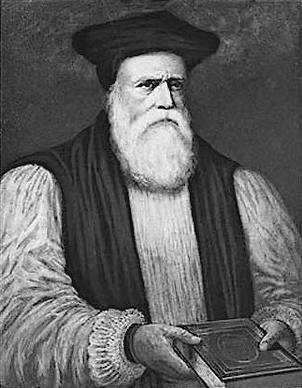
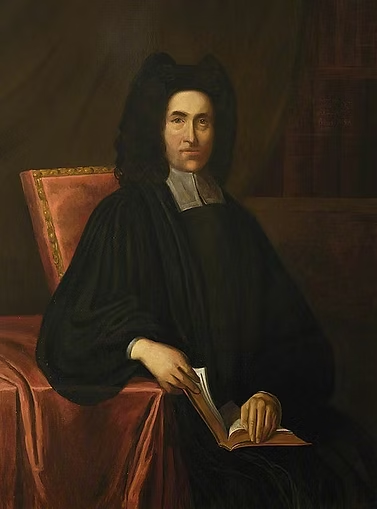
Portrait of Bishop William Morgan holding his Bible
Bishop William Morgan, translator of the 1588 Welsh Bible
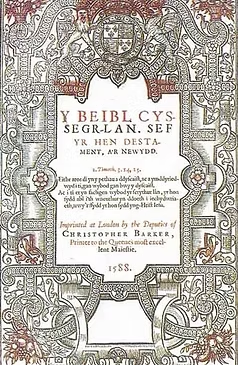
Title page of Y Beibl Cyssegr-lan, 1588
Y Beibl Cyssegr-lan, London, 1588
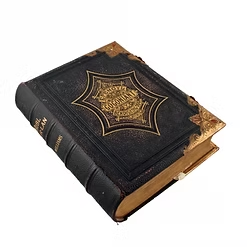
A Victorian Welsh family Bible with brass clasps
A Welsh family Bible of the pioneers’ own century
1698–1789

Schools and Bibles for the people

In 1698 the Rev. Thomas Bray and a small group of associates founded the Society for Promoting Christian Knowledge. Continuing the work of Thomas Gouge, the Society distributed devotional books in Welsh and English and resolved to set up Welsh schools — “that being the language which the parents best understood.” Between 1699 and 1740, twelve charity schools were established in Montgomeryshire alone; in 1690 Bishop William Lloyd had promoted a Welsh folio edition of 10,000 copies, Beibl yr Esgob Llwyd, and from 1777 to 1789 the Society published about 100,000 People’s Bibles in Welsh.

Griffith Jones, rector of Llanddowror, carried the work on with the Circulating Welsh Charity Schools of 1738–1761 — winter schools that moved from place to place every three months, teaching children to read the Welsh Bible. Eighty-seven such schools were held in twenty Montgomeryshire places, including Aberhafesp, Llanbrynmair, Llanwrin and Penegoes. The ground was well prepared for a religious and national revival.

On 8 March 1698, the Rev. Thomas Bray met a small group of friends at Lincoln’s Inn — Sir Humphrey Mackworth, Colonel Maynard Colchester, Lord Guilford and John Hooke. These men were concerned by what they saw as the “growth in vice and immorality” in England at the time, which they believed was owing to the “gross ignorance of the principles of the Christian religion”. They were also committed to promoting “religion and learning in the plantations abroad”. They resolved to meet regularly, and decided their aims could best be achieved by publishing and distributing Christian literature and encouraging Christian education at all levels.

The Society continued the work of Thomas Gouge in distributing devotional books and pamphlets in Welsh and English. Clergy societies were set up in Wales, including in Montgomeryshire, and it was decided to establish Welsh schools — “that being the language which the parents best understood”. Between 1699 and 1740, twelve charity schools were established in Montgomeryshire. In 1690 Bishop William Lloyd promoted a Welsh folio edition of 10,000 copies known as Beibl yr Esgob Llwyd, and from 1777 to 1789 the Society published about 100,000 People’s Bibles in the Welsh language.

The work of the SPCK was continued by the Circulating Welsh Charity Schools, from 1738 to 1761, under the organisation and guidance of Griffith Jones, rector of Llanddowror, Carmarthenshire. The object was to teach the children to read the Welsh Bible, to learn the church catechism, to sing psalms, to pray at home and to attend public worship on the sabbath. The schools moved from place to place, usually held in the winter and moving on after about three months. Eighty-seven such schools were known to have been held in twenty places in Montgomeryshire, including Aberhafesp, Llanbrynmair, Llanwrin and Penegoes.

Thus the ground was well prepared for a religious and national revival. Many of the Welsh nation’s clergymen were moved upon to produce or translate worthy texts for their unenlightened flocks.

Portrait of the Rev. Thomas Bray, founder of the SPCK
The Rev. Thomas Bray, who founded the SPCK in 1698
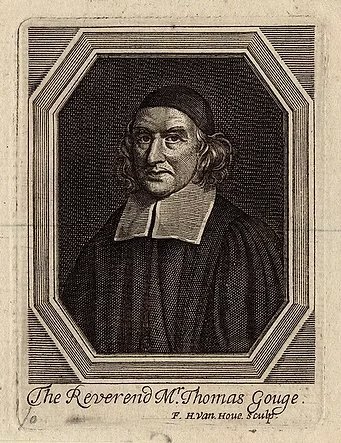
Engraved portrait of the Reverend Mr Thomas Gouge
The Rev. Thomas Gouge, whose distribution of Welsh books the Society continued
1784–1864

Mary Jones walks to Bala

Mary Jones was born at Llanfihangel-y-Pennant on 16 December 1784. She learned to read at the village school, and wanted a Bible in her own language. Having saved for several years, in 1800 she walked to Bala, where the Calvinistic Methodist minister Thomas Charles supplied her with one. She died on 28 December 1864.

Her experience became closely associated with the movement that led to the founding of the British and Foreign Bible Society by Thomas Charles and others in 1804.

The episode is often retold with dialogue and scene-by-scene detail. The reliably documented core is set out above; the dramatised versions are later retellings.

A country that had walked to Bala for scripture in its own tongue would, forty years later, cross an ocean for its faith.
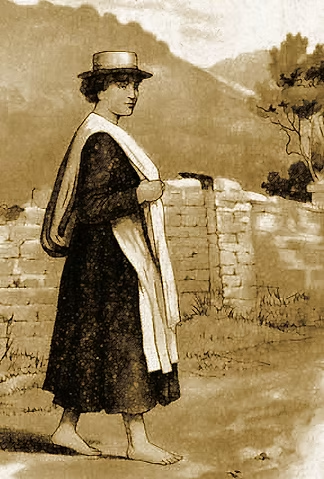
Illustration of Mary Jones walking barefoot with her bundle
Mary Jones on the road to Bala

The account preserved of her childhood explains why the walk mattered. On Sunday mornings Mary walked two miles to the little chapel in the village, where the minister opened a large, black, leather-bound book with two words in gold on the cover. She guessed they said “Holy Bible”, because she had heard him name it. The words inside looked odd to her. “How can anyone ever make sense of these squiggles?” she thought. “Oh, how I wish I could read this book for myself, or even have one for my own!”

Then a school opened in the village. The schoolmaster, Mr Evans, and his wife moved into a farmhouse not far from Mary’s home, and she worked extra hard to finish her chores so she could go there to learn to read. Months passed and seasons changed, until at last she was asked to read from the chapel Bible one Sunday morning. She was not very tall, so a wooden box was found for her to stand on. The squiggles were no longer strange to her. She read perfectly.

After the service she rushed to her mother. “I must have a Bible, I must have a Bible!” Her mother answered gently that Bibles were expensive and they had not much money. “I know, I know, that’s why I am going to save up for one, and I don’t care how long it takes me. I’ll do jobs for other people, I’ll save all my pennies, I’ll do anything just to have my own Bible.”

That is exactly what she did. Six years later, with her purse of money and some bread and cheese tied in a bundle, she set out for Bala, where Mr Evans had told her a man had Bibles. She followed many paths, crossed valleys and streams and found her way around hills, until she came to the brow of a hill and saw the edge of a town at dusk, candlelight beginning to flicker in cottage windows.

After knocking on several doors she found Mr Charles’s house, and made her request with the words tumbling over themselves: “I’ve walked twenty-five miles to get here, I’ve saved up for six years to buy a Bible, I’ve got the money here, you can count it if you like — please can I have a Bible?” He told her she had better come in, but first must have something to eat, and sent her to the kitchen with the housekeeper. When she had eaten and told him everything, he held out to her a brand new Bible. She stared at it for a long moment before taking it with both hands.

In his study afterwards, Thomas Charles remembered the girl disappearing over the brow of the hill still holding the Bible to her chest — a Bible written in her own language — and began to think of all the other Mary Joneses who must be wanting Bibles, not only in Wales but in England, Scotland, Ireland and further off still. In 1804 the British and Foreign Bible Society was formed by Thomas Charles and others, in response to needs that stories like hers had brought to light.

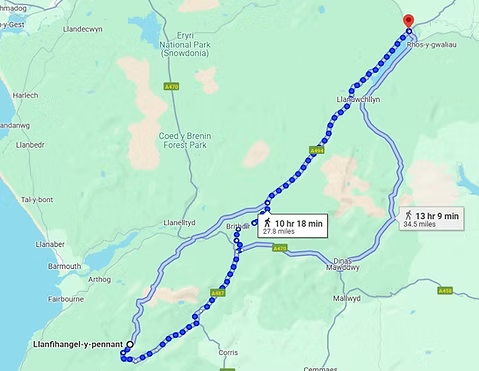
Map of the walking route from Llanfihangel-y-Pennant to Bala
Llanfihangel-y-Pennant to Bala — the road she walked, about twenty-six miles
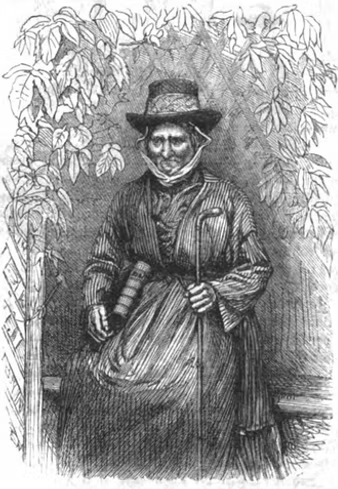
Engraving of Mary Jones in old age, seated with her Bible
Mary Jones in old age, with her Bible
1849

Two contrasting journeys

The crossing of 1849 shows both faces of the road to Zion. On the ocean, the Hartley’s fifty-four days were “more like a pleasure excursion than a long journey” — one death, one birth, gentle winds the whole way from Liverpool to New Orleans.

Then came the river. The Mameluke left New Orleans on 29 April and cholera raged fearfully aboard — about sixty died. The survivors waited four days at St Louis, boarded the Lightford for Council Bluffs, and lost eight or ten more before the current forced them ashore at Savannah landing to fend for themselves. The Mameluke herself was later destroyed at St Louis when the burning steamboat Edward Bates drifted into her.

The voyage of the Hartley →
Continue exploring
Timeline
The migration years
1840–1890
Person
Captain Dan Jones
The missionary who lit the fire
Person
John S. Davis
Scripture in Welsh, again — 1851
Ship
Hartley
The two journeys of 1849